Wills and Lasting Power of Attorney
What happens if you do not have either in place and how to fix that.
The law around wills and powers of attorney differs across the UK. This page covers England and Wales and Scotland separately where the rules differ. If you are based in Northern Ireland, the rules differ again and you should seek local legal advice. This page covers general information only. It is not legal advice. Always consult a qualified solicitor for guidance specific to your situation.

Most people know they should have a will. Very few actually have one. And almost no one thinks about a power of attorney until they need one, by which point it is too late to put one in place.
If you are building an investment portfolio, contributing to a pension, or accumulating any meaningful assets, both documents matter.
Wills
What is a will?

A will is a legal document that sets out what you want to happen to your assets when you die. Without one, your estate is distributed according to the rules of intestacy, a fixed legal formula that may have nothing to do with your actual wishes.
What a will can cover:
- Who receives your assets (your beneficiaries)
- Who manages your estate (your executor)
- Who looks after your children if they are under 18 (your guardian)
- Specific gifts of money, property, or possessions
- Charitable donations
- Funeral wishes
What a will does not cover:
- Pension funds, which are nominated separately (see the pension beneficiaries guide)
- Assets held in joint names, which pass automatically to the surviving joint owner
- Life insurance written in trust, which pays outside the estate
What happens without a will: England and Wales
Under the intestacy rules in England and Wales:
- If you are married with children, your spouse receives the first £322,000 plus half of anything above that. Your children receive the other half.
- If you are unmarried, your partner receives nothing, regardless of how long you have been together or whether you share a home.
- If you have no close relatives, your estate passes to the Crown.
Intestacy rules are also inflexible around specific gifts, charitable wishes, and unusual family structures. A will lets you specify all of this.
For a will to be valid in England and Wales it must be in writing, signed by you in the presence of two witnesses, and signed by both witnesses in your presence. Witnesses cannot be beneficiaries or the spouse of a beneficiary. If they are, the will remains valid but the gift to that person fails.
In England and Wales, marriage automatically revokes an existing will. If you marry after making a will, the will is no longer valid and you need to make a new one.
What happens without a will: Scotland
Scotland has its own intestacy rules under the Succession (Scotland) Act 1964, and they work differently.
Scottish intestacy operates in three layers.
Prior rights give a surviving spouse or civil partner automatic rights to the family home (up to £473,000), furniture (up to £29,000), and a financial provision (up to £50,000 if there are children, or £89,000 if there are not). These figures are set by Scottish Ministers and updated periodically.
Legal rights (known as ius relictae for a surviving spouse, and legitim for children) give a surviving spouse and children a fixed share of the moveable estate regardless of what any will says. Children have the right to claim one third of the moveable estate if there is a surviving spouse, or one half if there is not. Legal rights cannot be removed by a will. They can be discharged voluntarily by the beneficiary, but not by the person making the will.
Free estate is whatever remains after prior rights and legal rights are satisfied, distributed according to the intestacy rules.
As in England and Wales, an unmarried partner in Scotland has no automatic right to inherit under intestacy, regardless of the length of the relationship or whether you lived together. The Family Law (Scotland) Act 2006 gives cohabiting partners the right to apply to court for a financial provision, but this is discretionary and limited to one year from the date of death. A will is the only reliable way to protect an unmarried partner.
For a will to be valid in Scotland it must be signed by you on every page. It should also be signed by one witness, which makes the will self-proving and easier to confirm as valid without going to court.
Unlike in England and Wales, marriage does not automatically revoke an existing will in Scotland. It is still best practice to review your will after marriage, but the existing document remains legally valid.
Because of the interaction with legal rights (legitim) and the wider framework of Scottish succession law, a solicitor is particularly worth considering in Scotland if your estate includes property, a blended family, or business interests.
How to get a will
Option 1: DIY via the government service For straightforward situations, the government offers a basic will-writing route. If your affairs are uncomplicated, you are married or in a civil partnership, and your wishes are straightforward, this can work well at minimal cost. Start at gov.uk. In Scotland, the equivalent starting point is mygov.scot.
Option 2: An online will-writing service Services from organisations such as Which? and various online platforms sit between a blank form and a full solicitor. Typical costs are £100 to £200 for a single will and £150 to £300 for mirror wills for a couple.
Option 3: A solicitor If your situation involves property abroad, business interests, a blended family, trusts, or significant assets, use a solicitor. Expect to pay £300 to £600 for a single will and £500 to £1,000 for mirror wills. In Scotland, contact the Law Society of Scotland to find a qualified solicitor.
When to review your will
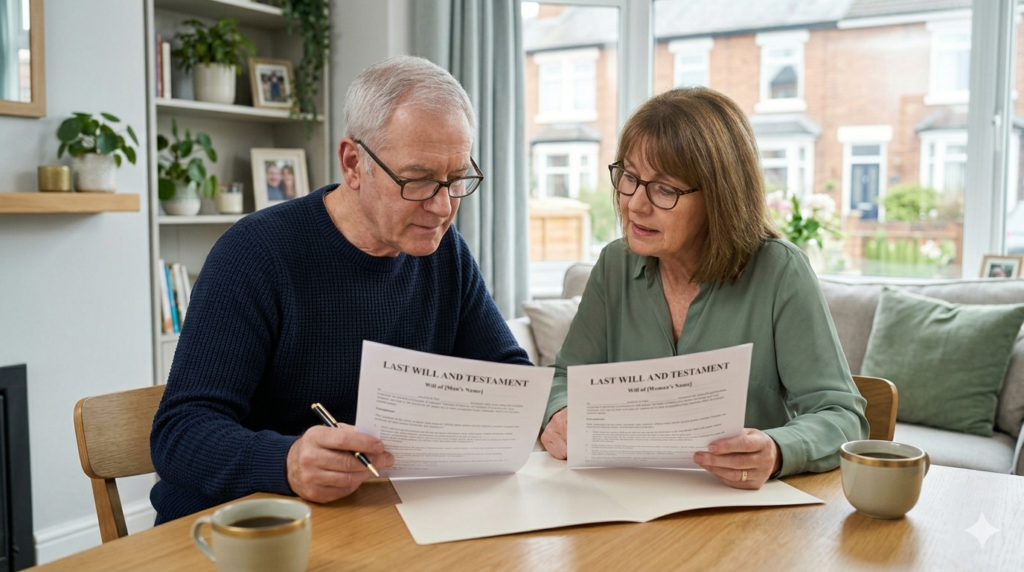
A will is not a set-and-forget document. Review it after any significant life change:
- Marriage (in England and Wales this automatically revokes an existing will, so a new one is essential)
- Divorce
- Birth of children or grandchildren
- Death of a named executor, guardian, or beneficiary
- Significant change in assets or financial circumstances
- Moving between different parts of the UK
A reasonable rule of thumb is to review your will every five years regardless of life changes.
Power of Attorney
What is a power of attorney?
A power of attorney is a legal document that allows someone you trust to make decisions on your behalf if you lose the mental capacity to do so yourself. This could be due to a stroke, dementia, a serious accident, or any other condition affecting your ability to make decisions.
The critical point is the same across the whole of the UK: you must put this document in place while you still have capacity. Once you lose capacity, it is too late to create one.
Why it matters for investors
Without a power of attorney, if you lose capacity, no one, including your spouse, has automatic legal authority to access your bank accounts or manage your investments. Your family would need to apply to a court to appoint someone to act on your behalf. This process takes months, costs significantly more, and gives the appointed person less flexibility than a properly registered power of attorney would have provided.
If you hold assets in a Stocks and Shares ISA, a SIPP, or other investment accounts, a power of attorney means the person you trust can keep managing those assets on your behalf rather than leaving them frozen during a lengthy legal process.
England and Wales: Lasting Power of Attorney
In England and Wales the document is called a Lasting Power of Attorney (LPA). There are two types.
Property and Financial Affairs LPA covers decisions about bank accounts, investments, property, and bills. This is the most relevant type for anyone with a significant investment portfolio or pension.
Health and Welfare LPA covers decisions about medical treatment, care arrangements, and day-to-day welfare. This type can only be used once you have lost capacity.
Both must be registered with the Office of the Public Guardian before they can be used. The process involves completing the LPA forms at gov.uk, having them signed by a certificate provider who confirms you have capacity and understand what you are signing, notifying any people you have named, and submitting to the Office of the Public Guardian with the registration fee of £82 per LPA. Registration currently takes up to 20 weeks.
Scotland: Continuing and Welfare Power of Attorney
In Scotland the equivalent document is a Power of Attorney under the Adults with Incapacity (Scotland) Act 2000. There are two equivalent types.
Continuing Power of Attorney covers financial and property matters. Unlike the England and Wales version, a Continuing POA can be used both while you have capacity and after you lose it, provided it was drawn up to continue in that way.
Welfare Power of Attorney covers health and personal welfare decisions. It can only be used once you have lost capacity to make those decisions yourself.
Both types must be registered with the Office of the Public Guardian (Scotland) before they can be used. Registration costs £90 and currently takes several weeks. A Scottish POA must be signed before a certificate provider, who may be a solicitor, a medical practitioner, or another prescribed professional. The certificate provider confirms that you understand what you are signing and are not being pressured into it.
If you lose capacity in Scotland without a registered POA in place, your family must apply to the Sheriff Court for a guardianship order. This is slower, more expensive, and gives the guardian less flexibility than a registered POA would have provided.
When to review your power of attorney
Review your power of attorney if your chosen attorney dies, loses capacity themselves, or if your relationship with them changes significantly. It is also worth reviewing if you move between different parts of the UK, as an LPA registered in England and Wales is not automatically valid in Scotland and vice versa.

Summary
A will ensures your assets go to the people you choose. A power of attorney ensures the people you trust can manage your affairs if you cannot. Both are straightforward to put in place and relatively inexpensive. Neither requires a financial adviser, just a solicitor or the government’s own service.
If you are investing for the long term, these two documents are part of the foundation.
What’s Next
A will and a power of attorney are the foundation. The next step is making sure your pension and life insurance actually reach the right people when the time comes.
Most people assume their pension passes through their will. It does not. Read the pension and life insurance beneficiaries guide to understand how nominations work and why an out of date form can undo careful planning.
This is general information, not legal advice. Consult a qualified solicitor for guidance specific to your situation.