Pocket Money and Financial Education: A Practical Guide by Age

Schools teach children to read, write, and solve equations. The vast majority teach them almost nothing about money, saving, or investing. The result is that most adults enter their financial lives without the basic mental frameworks that would have served them well for decades.
The good news is that the fundamentals of a healthy money mindset are not complicated, and they can be taught at home, in age-appropriate ways, starting from very early childhood. This page gives you a practical guide to financial education by age, including pocket money approaches, specific conversations to have, and tools that work.
The Foundational Principles: Before the Specifics
Regardless of age, a few principles underpin all good financial education at home:
- Money is a tool, not a measure of worth. Children who grow up in households where money is discussed openly and treated instrumentally develop healthier relationships with it than those where it’s either a taboo or an obsession.
- Make it real. Abstract lessons don’t land. A child who saves physical coins toward a visible goal learns delayed gratification better than one who is told to ‘be sensible with money’ in the abstract.
- Allow mistakes at low stakes. A child who spends their pocket money on something they regret learns more from that experience than from being prevented from making the choice. The lesson at age 10 with £5 is cheap. The same lesson at 22 with a credit card is not.
- Model the behaviour you want to see. Children watch what adults do with money more than they listen to what they say about it. If you talk openly about budgets, saving decisions, and trade-offs, they absorb that framework naturally.
Ages 3-5: First Concepts
Money is physical and finite. That’s the entire curriculum at this age.
Let children handle coins and notes. Let them watch you pay for things. Give them coins to hand to a shopkeeper. The concept that you exchange money to get things, and that once it’s given, it’s gone, is the foundation everything else builds on.
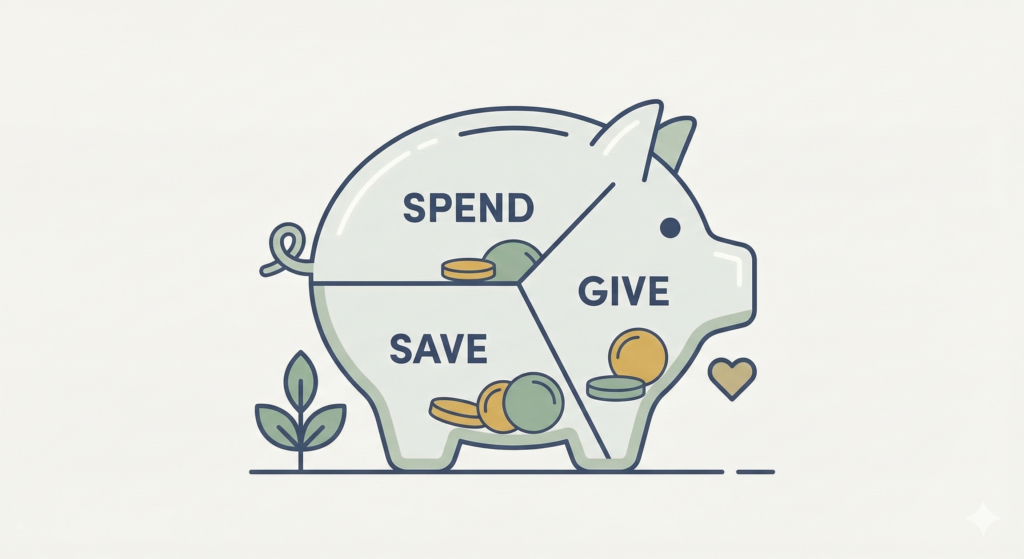
A simple divided piggy bank with ‘spend’, ‘save’, and ‘give’ sections introduces the idea that money can be allocated by purpose. Don’t over-explain, the physical act of sorting coins is the lesson.
| The ice cream lesson One of the most effective early money lessons: give a young child enough money to buy one ice cream, and tell them they can have it now or save the money and get two ice creams next week. You’ll get a range of responses, and all of them are valuable learning, whether they choose now or later. The concept of delayed gratification, introduced through something genuinely desirable to the child, is the most financially important habit that exists. |
Ages 6-10: Earning, Saving, and Choosing
This is the age where pocket money becomes genuinely useful as a teaching tool, provided it’s structured thoughtfully.
The pocket money debate, chores or allowance?
There are two camps: pocket money as a fixed weekly allowance (unconditional), or pocket money tied to completing household tasks. Both have merit. A fixed allowance teaches children to manage money over time; task-based pocket money teaches that effort generates reward.
A practical middle ground: a small base amount that arrives unconditionally, with the opportunity to earn additional amounts through specific contributions to the household. This mirrors how adult financial life actually works, you have a baseline income and can take on additional work for more.
Saving toward something specific
The most effective exercise at this age: identify something the child genuinely wants that costs more than their pocket money, but not so much that it would take more than a few months to save for. Help them calculate how many weeks of saving are needed. Then let them save, track progress, and experience the satisfaction of reaching the goal themselves.
The goal must be something they actually want, not something you approve of. The lesson is about their motivation and patience, not yours.
The three-jar system
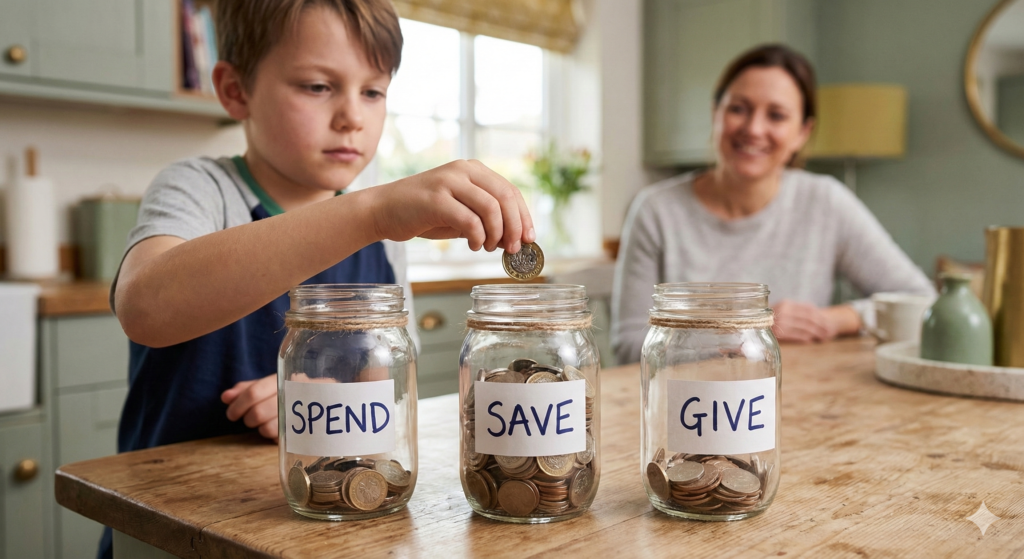
A practical framework many families use: three transparent jars labelled Spend, Save, and Give. Each pocket money payment is divided between the three. The proportions can be adjusted, but having something allocated to each category every week builds the habit of intentional allocation rather than thoughtless spending.
| Jar | Suggested % | Purpose |
| Spend | 40-50% | For immediate enjoyment, sweets, small toys, entertainment. No guilt, no saving. |
| Save | 40-50% | Toward a specific goal. Makes saving visible and purposeful rather than abstract. |
| Give | 10% | Charity, a gift for someone, a cause they care about. Builds perspective and generosity. |
Ages 10-14: Budgeting and Real Decisions
At this age, giving children a defined budget for a broader category, clothing, entertainment, gifts for friends, teaches budgeting under real constraints. They make choices, run out of money occasionally, and learn to plan ahead. These are adult skills, and the stakes are low enough that mistakes are genuinely educational.
Introducing the concept of interest
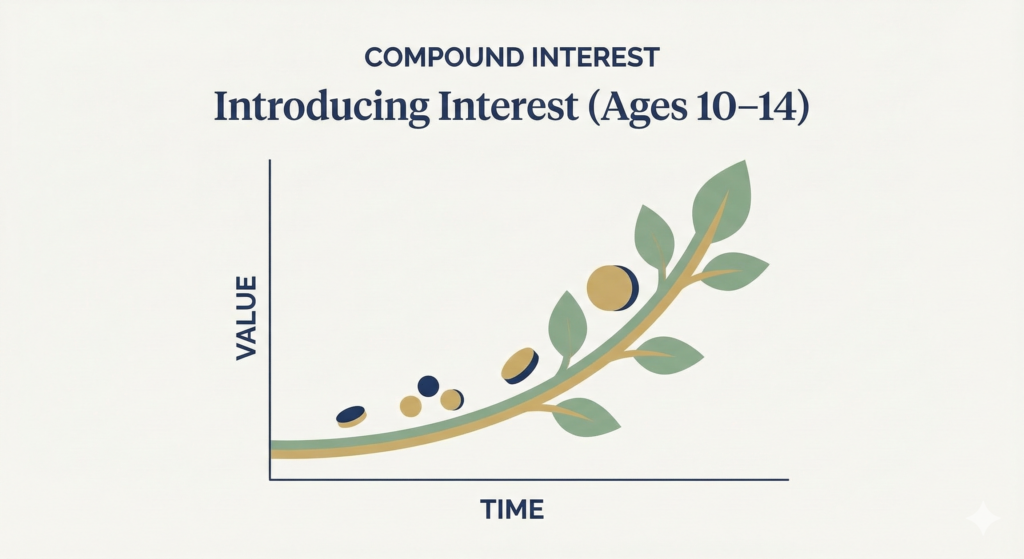
This is the age where compound interest can be meaningfully explained. A parent can play ‘the bank’, offering to pay 10% per month on any money the child leaves in the ‘family bank’. Let them see the balance grow. The contrast with spending the money is visceral and memorable.
Alternatively, show them a simple compound interest calculator online and let them enter their own numbers. Children who see what £100 becomes at 7% over 40 years remember it.
Talking about the family budget
Age-appropriate transparency about household finances, not anxiety-inducing, but honest, helps children understand that adults make trade-offs too. Explaining that the family chooses to go on one good holiday instead of two cheaper ones because quality matters more than quantity is a real lesson in values-based spending.
Ages 14-18: Investment and Independence
This is the age where abstract concepts become real and actionable. A teenager who understands the following is better prepared for adult financial life than most actual adults:
- What compound interest is and why it means starting early matters enormously
- The difference between an asset (something that grows in value or generates income) and a liability (something that costs money to maintain)
- What a payslip looks like, income tax, national insurance, pension contributions, take-home pay
- What a Junior ISA is, what it’s worth, and what it could become if left invested
- The rough concept of a budget, income minus fixed costs minus savings equals disposable income
Part-time work
A part-time job at 16-17, even a few hours a week in retail, hospitality, or tutoring, teaches things no classroom lesson can: the relationship between time and money, what it feels like to earn, the value of a pound that required effort to make. Many adults cite their first job as the most influential financial education they received.
Their own bank account

Most UK banks offer current accounts for teenagers from age 11-13, with spending tracking via app. Letting a teenager manage their own account, including seeing it go low when they’ve overspent, is the most effective practical financial education available. The app makes the numbers visible and real in a way that cash never quite does.
| What NOT to do The most common parenting mistake in financial education is rescuing children from the consequences of poor money decisions. If your teenager spends their clothing budget in week one and has nothing for the rest of the month, the uncomfortable weeks that follow are the lesson. Topping them up removes it entirely. The lesson from being rescued is ‘overspending has no consequences’, which is exactly the wrong thing to learn. |
| Not financial advice This page is an educational overview of approaches to teaching children and teenagers about money. The strategies described are practical frameworks, not prescriptive rules, different approaches work for different families and children. The financial products mentioned (Junior ISAs, bank accounts, SIPPs) are covered in more detail in the relevant pages in this section. |